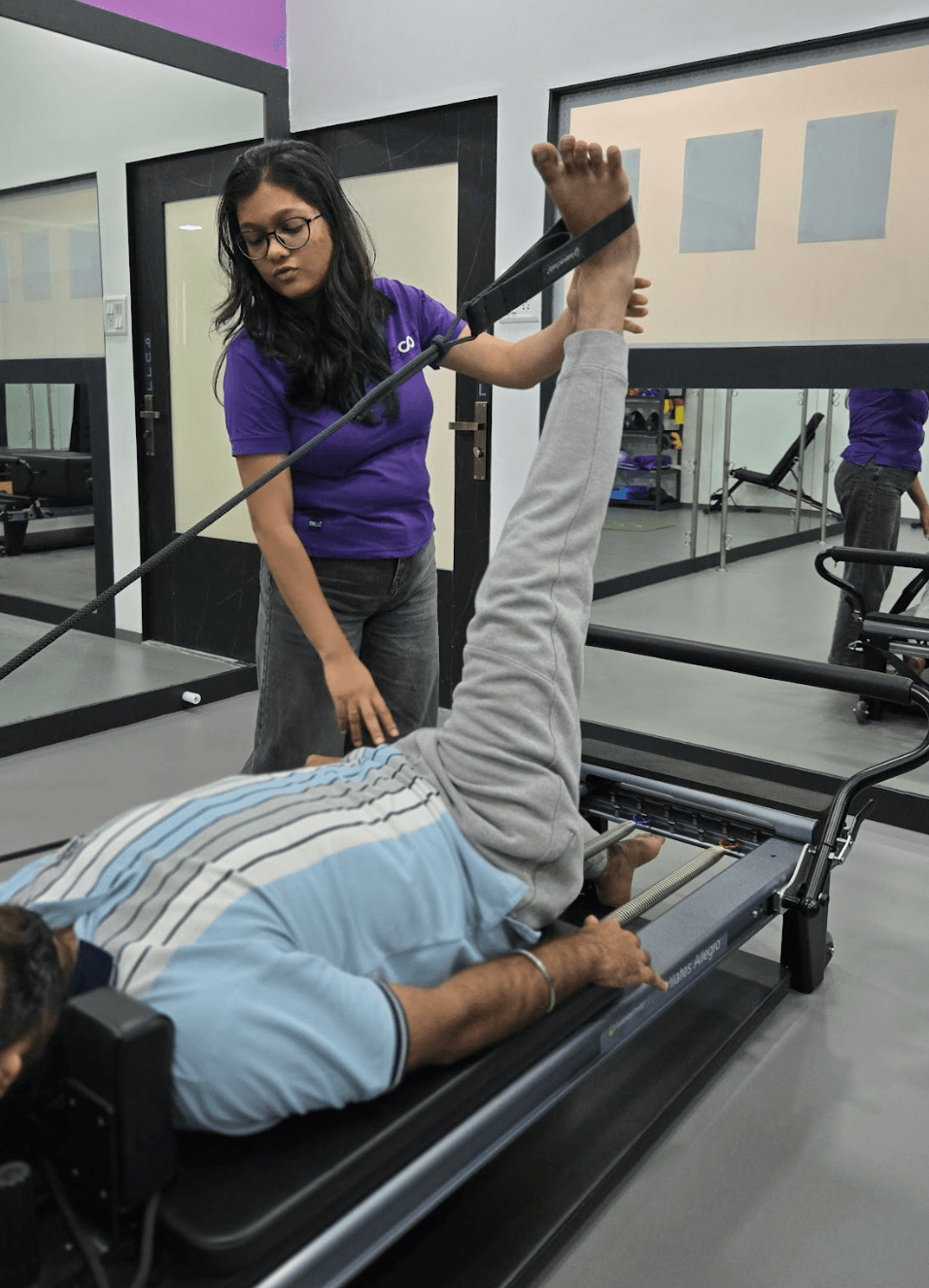
Clinical Pilates for Back Pain in Mumbai
L4-L5 disc, lumbar instability, chronic back pain, physiotherapist-led programs at R3BOOT, Dadar East.
Is Clinical Pilates Good for Back Pain?
Yes, and it is one of the most evidence-supported interventions for chronic lower back pain available. Research shows clinical Pilates outperforms standard physiotherapy for back pain outcomes when continued beyond the acute phase. The reason: most lower back pain is a motor control problem. The deep stabilisers, lumbar multifidus, transversus abdominis, pelvic floor, stop functioning correctly after injury or chronic pain, and no amount of stretching or passive treatment rebuilds them. Clinical Pilates does.
At R3BOOT in Dadar East, Dr. Hiral Parikh (BPT, 15+ years) and Dr. Vaishali Vijay Rauniyar (BPT, 4+ years, certified Dry Needling, Aquatic Rehabilitation) design your program from a physiotherapy assessment of your specific spine pathology. L4-L5 disc, L5-S1 instability, facet joint pain, muscular back pain, post-fusion, each requires a different exercise selection. Generic Pilates classes use the same routine for all backs. Clinical Pilates is different for every spine.
SPINE CONDITIONS WE TREAT WITH CLINICAL PILATES
L4-L5 Disc Bulge / Herniation
Disc material compresses the nerve root at L4-L5, causing pain, numbness, or weakness in the leg
Pilates approach: Segmental stabilisation at L4-L5, lumbar multifidus activation, load-free spinal decompression exercises
L5-S1 Disc Degeneration
Loss of disc height and instability at the lumbosacral junction, common in desk workers and heavy lifters
Pilates approach: Deep core recruitment, segmental control, hip mobility work to reduce lumbosacral compression
Lumbar Facet Joint Pain
Extension-based pain aggravated by standing, walking, or backward bending
Pilates approach: Flexion-biased stabilisation, hip flexor lengthening, movement pattern retraining to offload facets
Muscular Chronic Lower Back Pain
Persistent lumbar tension from glute inhibition, hip flexor tightness, and erector hypertonicity
Pilates approach: Glute activation sequencing, hip flexor lengthening under load, erector decompression through movement
Post-Discectomy / Post-Fusion Rehab
Muscle inhibition and movement fear after spinal surgery, common barrier to full recovery
Pilates approach: Graded movement exposure, scar tissue mobilisation support, progressive spinal loading
Sacroiliac Joint Dysfunction
SIJ instability or hypermobility causing low back and gluteal pain, often worse on one side
Pilates approach: SIJ stabilisation, glute medius activation, pelvic floor coordination exercises
WHO WE HELP //
- L4-L5 or L5-S1 disc pathology
- Chronic lower back pain (3+ months)
- Post-spinal surgery rehab
- Facet joint and SIJ pain
- Desk workers with lumbar stiffness
- Athletes with recurring back injuries
Why Group Pilates Classes Often Make Back Pain Worse
Standard Pilates classes in Mumbai, whether instructor-led group sessions or general reformer classes at fitness studios, are built on the assumption that all participants have healthy spines. The roll-up, the hundred, double leg stretch, and similar exercises are fundamental to most Pilates class structures. For someone with an active L4-L5 disc herniation, these movements increase intradiscal pressure and can provoke or worsen nerve symptoms. A group instructor, regardless of their certification level, is not equipped to screen for this.
The deeper issue is that lower back pain driven by disc pathology, facet joint irritation, or sacroiliac dysfunction each has a different pain mechanism and a different exercise tolerance. Flexion-based movements aggravate disc herniations. Extension-based movements aggravate facet pain. Rotational loading without stability aggravates SIJ dysfunction. A class that mixes these presentations, which every general Pilates class does, cannot account for all of them simultaneously.
At R3BOOT in Dadar East, Mumbai, Dr. Hiral Parikh screens every client for their specific pain mechanism at the first session. Exercises that load the pain generator are excluded. The program starts in the pain-free range and expands as stability improves. Most clients with acute or sub-acute back pain notice meaningful reduction in symptoms within 4–6 sessions. Chronic presentations require more time, but the trajectory is consistently positive when the program is built from accurate physiotherapy assessment rather than a generic back pain template.
What Happens in a Back Pain Pilates Session
Physiotherapy Assessment
Your physiotherapist identifies your specific spine pathology, pain pattern, and motor control deficits. Imaging reports (MRI, X-ray) reviewed. Exercise contraindications established. This is what separates clinical Pilates from a class.
Prescribed Program
Exercises selected for your specific diagnosis, not a back pain template. L4-L5 disc herniation requires different exercise selection than facet joint pain or SIJ dysfunction. Every movement has a clinical reason for your particular spine.
Progressive Loading
Program advances based on your clinical response, not a weekly class schedule. Home exercise program taught in parallel. Physiotherapy manual therapy or dry needling added in the same session where appropriate.
Clinical Pilates for Back Pain, Dadar East Clinic
R3BOOT is at Palai Plaza, Swami Gyan Jivandas Marg, Dadar East, 5 minutes from Dadar Central Line station. Mumbai's only integrated recovery centre combining physiotherapist-led clinical Pilates with sports massage, ice bath, contrast therapy, and physiotherapy in one location. Clients come from Parel, Matunga, Sion, Worli, Lower Parel, and Bandra for the clinical standard unavailable in general fitness studios.
ADDRESS
Palai Plaza, 203
Swami Gyan Jivandas Marg
Dadar East, Mumbai – 400 014
HOURS
Monday – Saturday
7:00 AM – 8:00 PM
Sunday by appointment
Stop Managing Back Pain. Rehabilitate It.
Clinical Pilates for back pain at R3BOOT, Dadar East. Assessment-first. Diagnosis-specific. Physiotherapist-led.
DADAR EAST, MUMBAI – 400 014