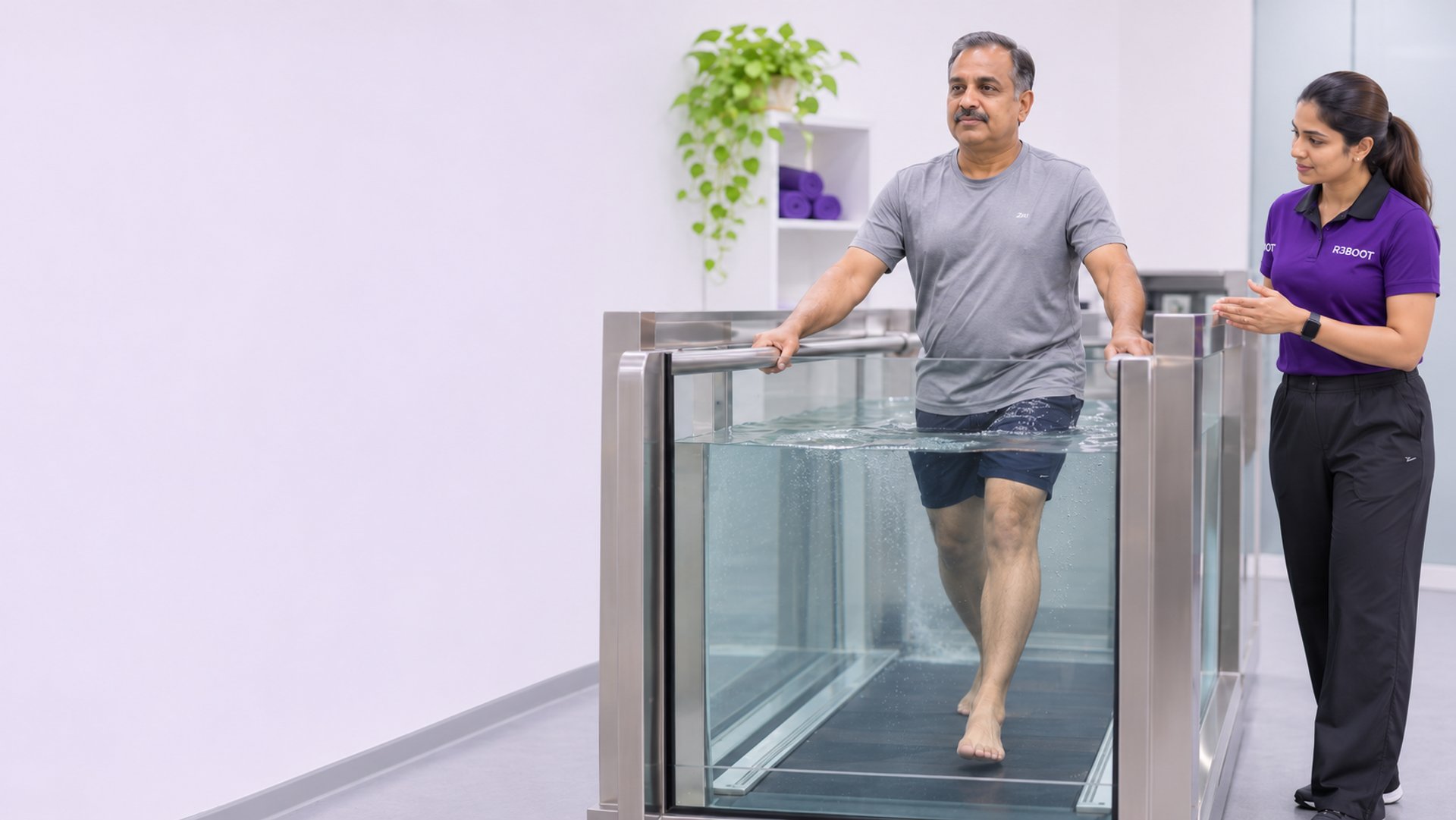
Aqua Therapy After Knee Replacement or ACL: When Is It Safe to Start?

Dr. Vaishali Vijay Rauniyar
Published 5 November 2026 · Updated 9 November 2026
“TL;DR: You can start aqua therapy after knee replacement or ACL surgery once your surgeon confirms the wound is fully healed and any stitches or staples are out. Water takes load off the knee, so you can walk and bend earlier and with less pain. It adds to land rehab; it does not replace it. Timelines differ a lot between the two surgeries.”
You had the surgery. Now you want to know when you can get in the water, and whether it is worth it.
Aqua therapy after knee replacement or ACL surgery is safe when the wound is healed and your surgeon agrees. It lets you load the knee gently while water carries part of your body weight. Dr. Vaishali Vijay Rauniyar is a physiotherapist at R3BOOT with certification in aquatic rehabilitation. At R3BOOT, she works with post-surgery clients on aqua treadmill sessions in Dadar to build a safe, step-by-step return to walking and sport.
This guide covers when to start, when to wait, what each stage looks like, and what the research really says.
Is aqua therapy safe after knee replacement or ACL surgery?
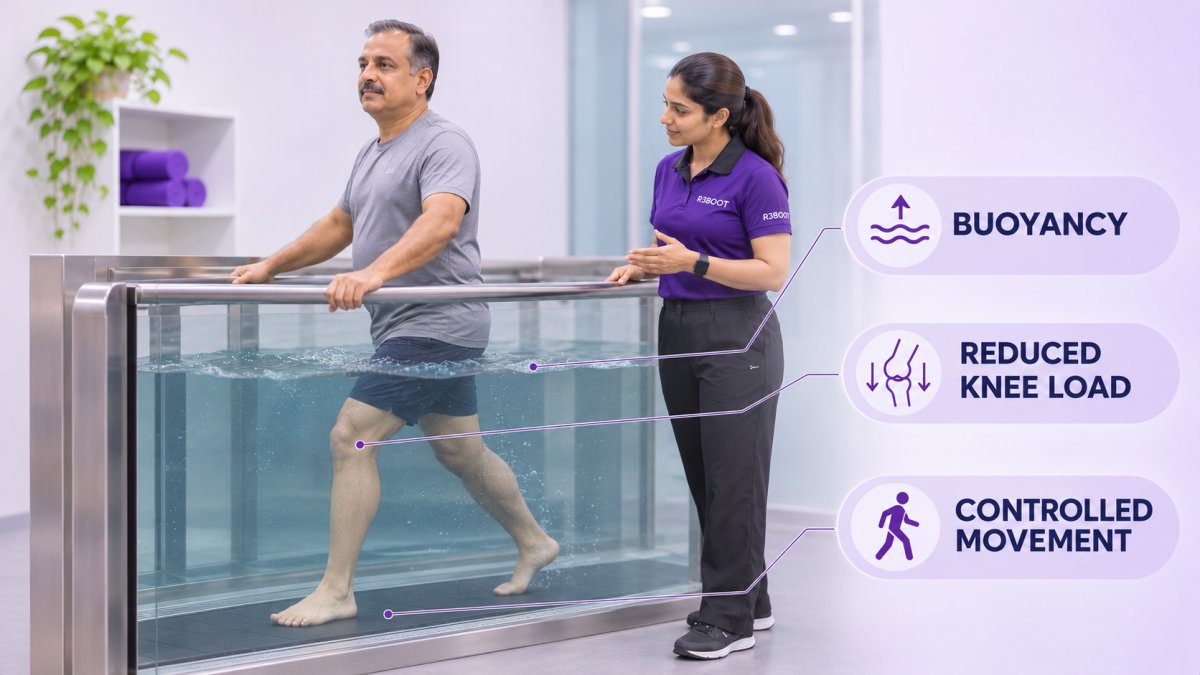
Yes, once your surgeon clears the wound and you have no infection, clot or fever. Water supports your body and lowers the load on the knee, so early walking and bending hurt less. It is a tool inside your rehab plan, not a shortcut around it.
Here is why it works. Water holds part of your weight up. The deeper you stand, the less your knee has to carry, and your posture changes the number too (study on weight-bearing in water). Warm water also eases stiffness, and the pressure of water helps limit swelling while you move.
That matters after surgery, because early rehab has one big problem: you need to move the knee, but the knee is sore, swollen and weak. Water lets you move it anyway.
In our clinic, the first thing we do is read your surgical notes. The type of surgery, the graft, any meniscus repair and your surgeon's protocol decide what we do in the water. We do not use a generic plan.
When can you start? Knee replacement vs ACL
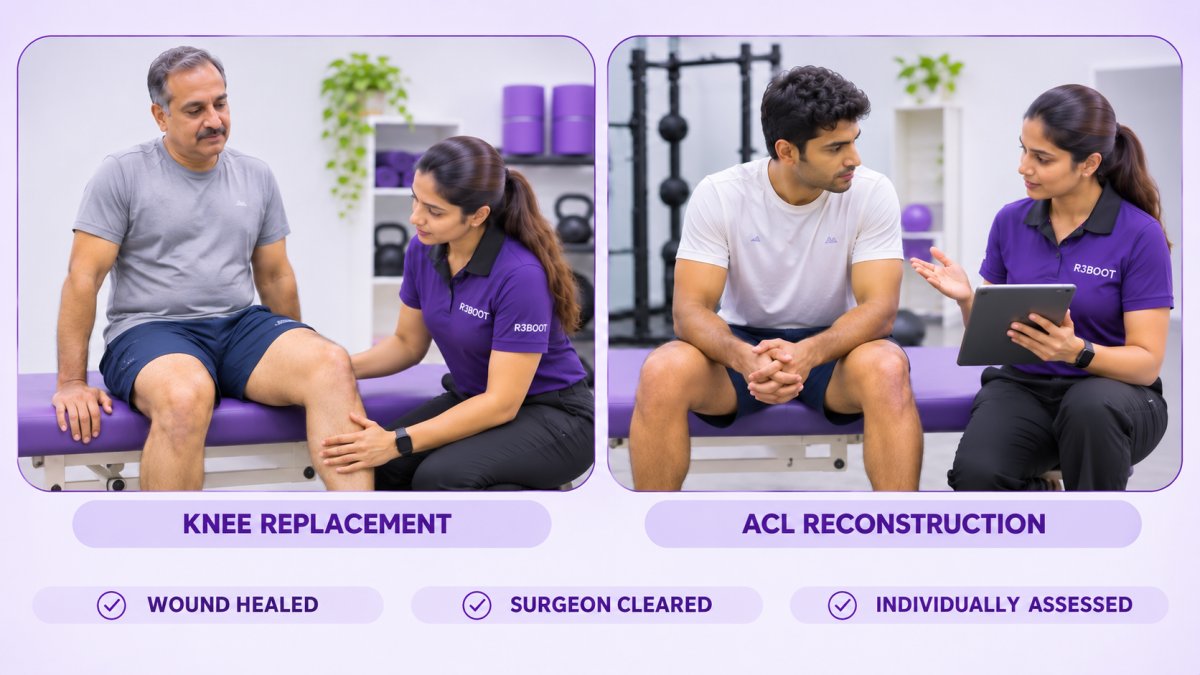
There is no single start date. Healing speed, your surgeon's protocol and your land-based progress decide it. Clinic protocols we reviewed put the first water session anywhere from about 2 to 12 weeks after surgery (one example protocol).
The two surgeries are not the same, so do not read them as one timeline.
| Stage | Total knee replacement | ACL reconstruction |
|---|---|---|
| Weeks 0 to 2 | Land only. Wound care, swelling control, first bending and walking with aids. | Land only. Swelling control, straightening the knee, quad activation. |
| Water starts | After the surgeon confirms the incision is fully healed and stitches or staples are out. Often a few weeks in, but the date is the surgeon's call. | Same wound rule. Graft type, meniscus repair and swelling can push the date later. |
| First water phase | Chest-deep walking, gentle bending, weight shifting. Goal: smooth walking and more knee bend. | Chest-deep walking, gentle bending, balance work. Goal: normal walking pattern, no swelling flare-up. |
| Middle phase | Walking at different speeds, step-ups, strength work with water resistance. | Controlled strengthening, single-leg balance, later light jogging in water if your surgeon agrees. |
| Land targets to watch | Many protocols aim for about 60 to 90 degrees of bend by week 2, 100 degrees by week 6, and 120 degrees by weeks 8 to 12 (Saudi MOH protocol). | Milestone-based. Strength, hop and movement-quality tests decide each step, not the calendar. |
| Full return | Usually 3 to 6 months for full daily activity. | Rehab runs 9 to 12 months in the Dutch guideline (KNGF guideline summary). |
At R3BOOT, knee replacement clients usually need 8 to 12 aqua sessions over 6 to 8 weeks once the surgeon has cleared the wound. Your physiotherapist gives you a number after the first assessment, based on your knee.
One practical flag for knee replacement: if you are still below 90 degrees of bend around week 6, talk to your surgeon. One hospital protocol advises exactly that (Lifespan protocol). Do not wait and hope.
When is it NOT safe to start aqua therapy?
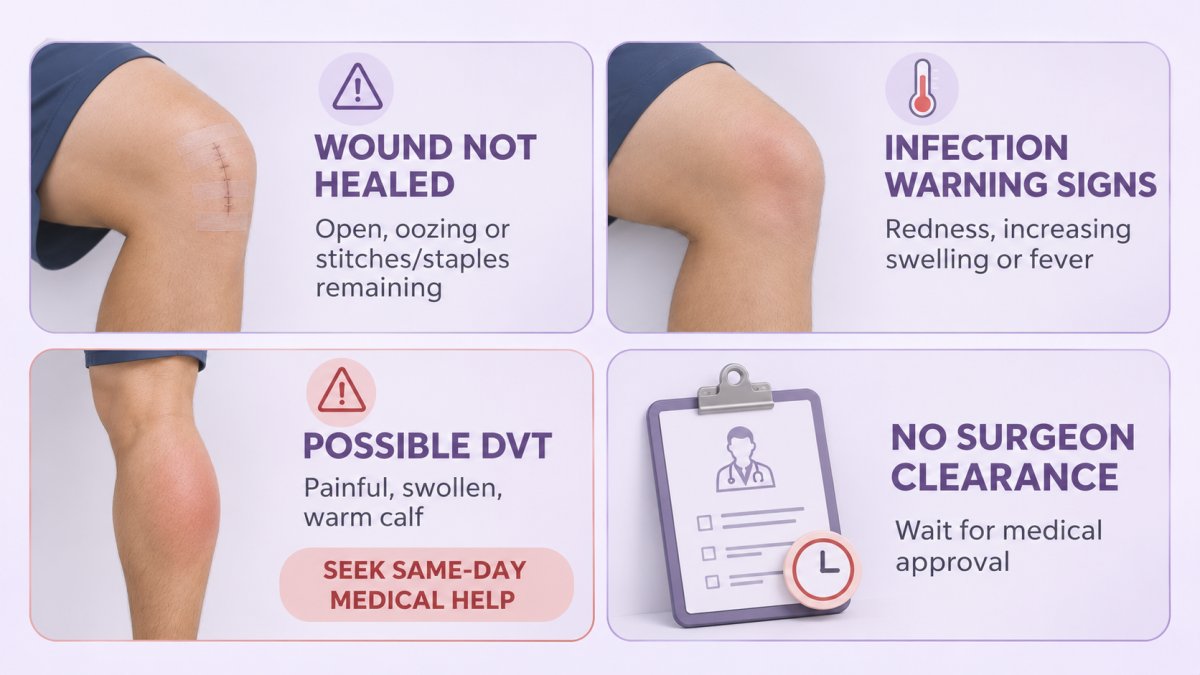
“Wait and call your surgeon if any of these apply:”
- The wound is open, oozing, or the stitches or staples are still in. Hospital aquatic policies list open wounds and skin infections as reasons to wait (NSW health policy).
- The incision is red, hot or more swollen than yesterday.
- You have a fever, or you feel unwell.
- You have a calf that is painful, swollen and warm. This can be a clot (DVT). Get medical help the same day. Acute DVT is a listed reason to avoid aquatic physiotherapy (NSW health policy).
- Your surgeon has not cleared you. Medical clearance can be required, and the list of precautions is not exhaustive (RCH aquatic physiotherapy guide).
These are temporary reasons to wait. They are not reasons to give up on water.
What does an aqua therapy session after knee surgery look like?
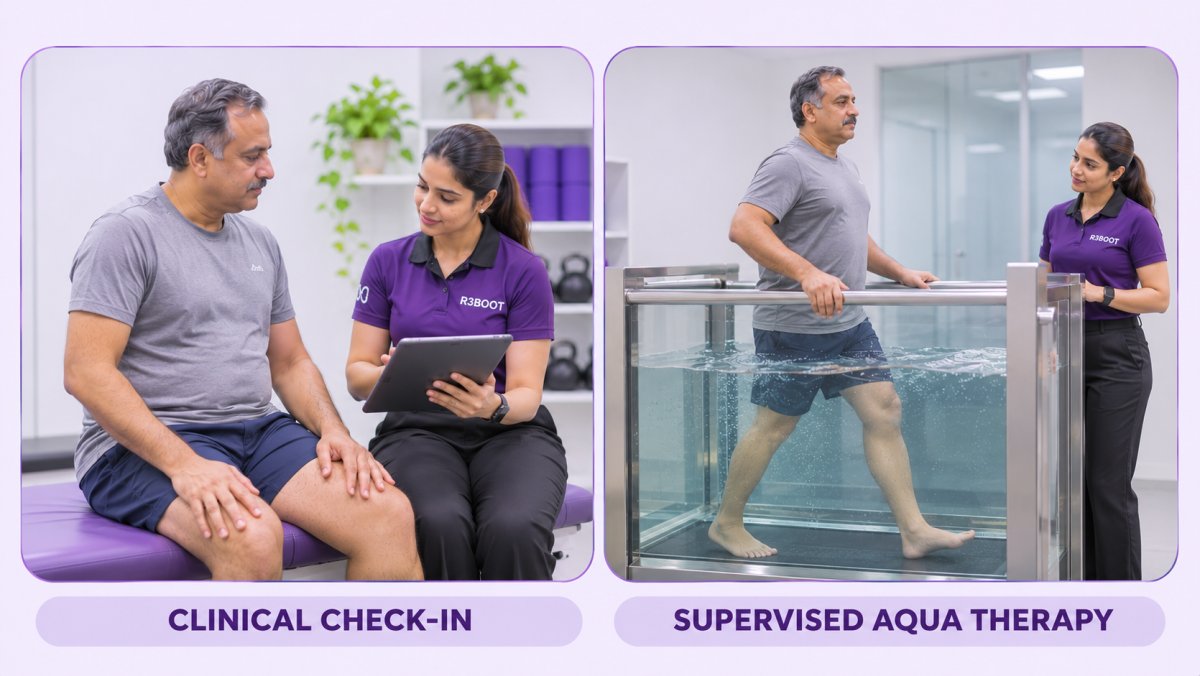
At R3BOOT, you stand and walk on an underwater treadmill inside a private, temperature-controlled chamber. Your physiotherapist stays with you the whole session and sets water level, speed and jets to your stage. You do not need to swim.
Sessions run 45 to 60 minutes. Water goes up to about 4 feet, and the treadmill runs from 0.1 to 15 km/h. That range lets us start with very slow walking and build up as your knee allows.
A typical session looks like this:
- Check-in. Pain, swelling, wound, how the last session felt.
- Warm-up in the water. Slow walking, easy knee bends.
- Main work. Walking drills, weight shifting, steps, balance and strength, depending on your stage.
- Cool down. Gentle stretches and a short review.
For a knee replacement, the focus early on is smooth, even walking and more bend. For an ACL, the focus is a normal walking pattern, control and confidence on that leg.
This is why we use a private chamber, not a shared pool. You get one-to-one attention, and the setup changes in real time. For a deeper look at who this suits, read who aqua treadmill physio is for.
Does water really beat land rehab? What the research says
Not clearly. Reviews of small trials suggest aquatic therapy is as good as land therapy after knee surgery, with possible gains in strength, knee bend and confidence. The studies are small, so treat it as a useful add-on rather than proven better.
Here is what we can say honestly:
- Knee replacement. A review of six randomized trials found that four favoured aquatic therapy on function, pain or quality of life, and one found no difference from land therapy (Goehring 2015 review). A later review found most studies showed benefit for muscle strength, but said the data were too thin for firm conclusions. It also hinted that starting water work early may matter (Zhuo 2021 review).
- ACL. In one randomized trial of 38 male athletes, adding 12 aquatic proprioception sessions to land rehab improved joint position sense (Hajouj 2021 trial). A small pilot of 20 patients found aquatic therapy helped restore step-length symmetry (2025 pilot trial).
What this means for you: water is a good bridge. It lets you move earlier and with less pain. But you still need land-based strengthening to finish rehab. Anyone who tells you water alone will fix your knee is selling something.
For ACL clients, "ready" is also not a date. Return-to-sport criteria differ a lot between studies, and many rely on time alone, even though how well those tests predict a safe return is still unclear (Burgi 2019 scoping review). The Dutch guideline suggests using strength tests, hop tests, movement quality and mental readiness together. When you reach that stage, our Pilates after ACL surgery guide covers the land-based side.
How many sessions will you need, and what does it cost?
A 45-minute aqua therapy session at R3BOOT is ₹2,000. Knee replacement clients usually need 8 to 12 sessions over 6 to 8 weeks. ACL plans run longer, because the rehab runs 9 to 12 months and water is only one part of it.
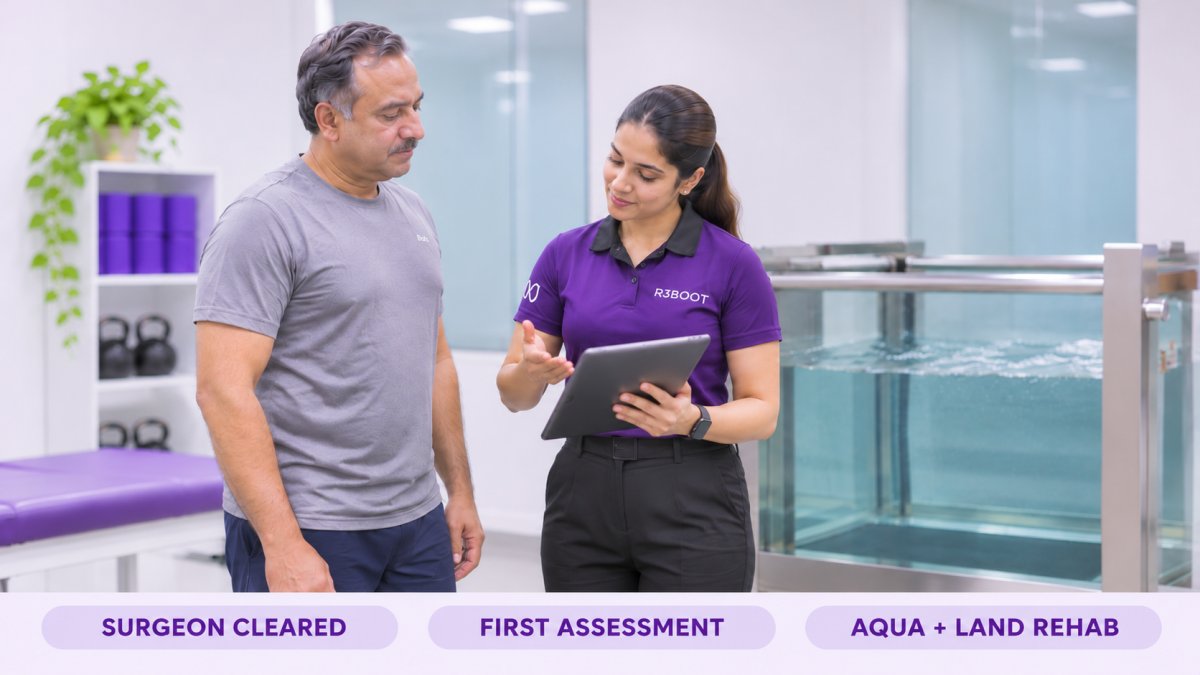
Your physiotherapist will give you a specific estimate after the first assessment. Bring your discharge summary, operative notes and any scans. If you do not have them, we ask the right questions to fill the gaps.
Aqua therapy works best alongside the rest of your recovery. Our post-surgery physiotherapy programme covers the land-based work, and our aqua therapy for knee pain page explains the wider knee programme. If your knee is worn out rather than newly operated on, see aqua therapy for knee arthritis.
Ready to start? Here is the plan
- Ask your surgeon: "Is the wound healed, and can I do water-based rehab now?"
- Bring your surgical notes to a first assessment.
- Start slow. Your physiotherapist sets the water level and speed.
- Keep up land exercises. Water adds to them; it does not replace them.
R3BOOT is at Palai Plaza, 203, Swami Gyan Jivandas Marg, Dadar East, Mumbai 400014, about 5 minutes from Dadar station. Contact us or call or WhatsApp +91 97023 68612 to book an assessment. Or read more about aqua therapy in Mumbai.
This article is general information, not medical advice. Your surgeon's protocol always comes first.
Physiotherapy in Dadar
Book the assessment, not another stretch routine
If this is changing how you walk, train, or sit at a desk, it belongs with a physiotherapist. R3BOOT is in Dadar East, 5 minutes from the station.
Physiotherapy at R3BOOT Dadar