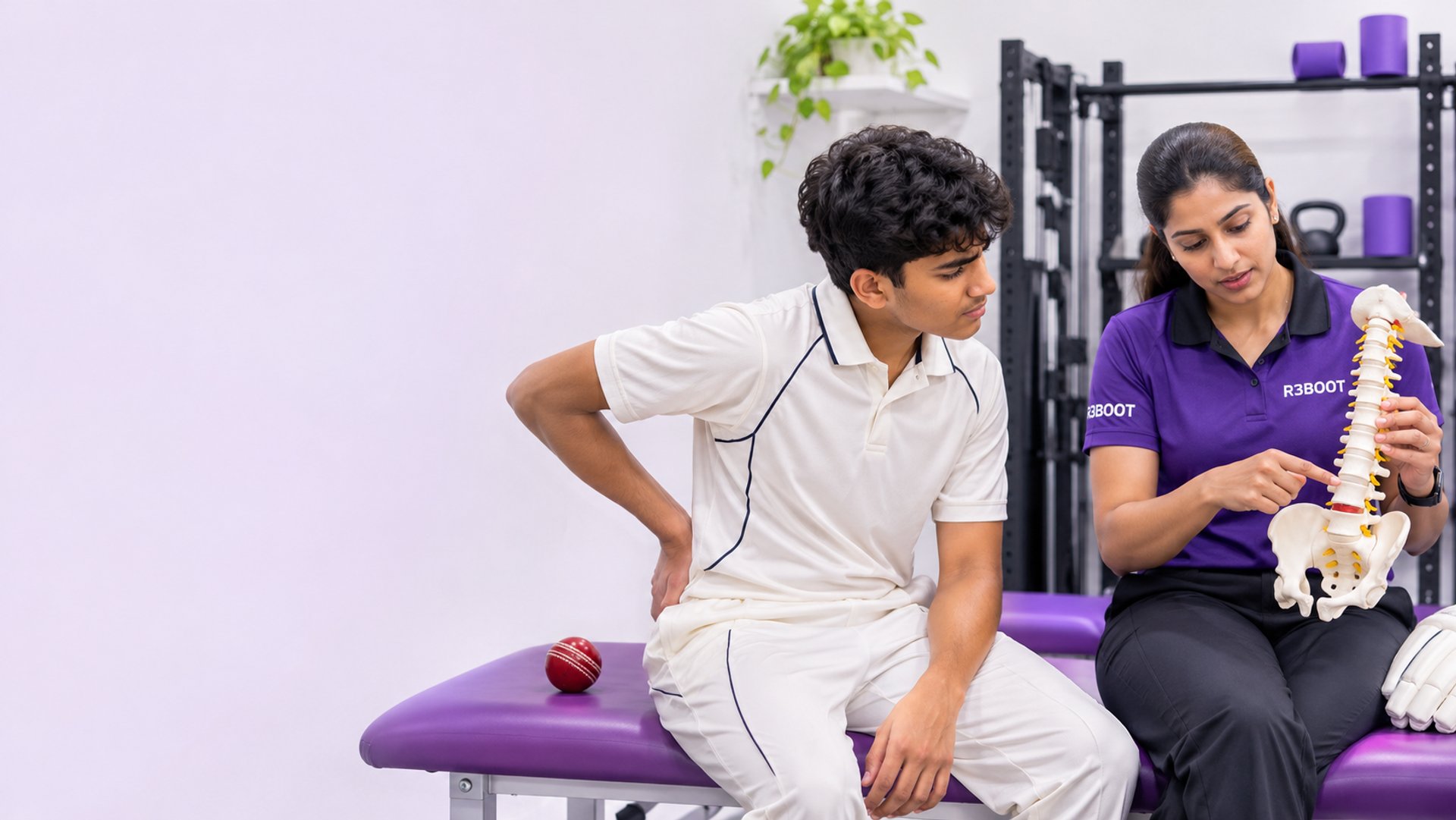
Spondylolysis in Young Cricketers: Back Pain, Scans and Return to Play

Dr. Hiral Parikh
Published 5 November 2026 · Updated 17 November 2026
TL;DR: Spondylolysis is a stress fracture in a small bone bridge of the lower spine. It is common in teenage fast bowlers. Back pain that keeps returning with bowling should be scanned, not guessed at. Most young athletes recover without surgery. Physiotherapy can start within days of diagnosis. The return date depends on symptoms, scans and testing, not the calendar.
“Medical note: This guide explains the injury and the rehab process. It does not replace a doctor's diagnosis. Only a doctor and a scan can confirm spondylolysis.”
A 15-year-old fast bowler says his lower back hurts after bowling. He rests for a week and it settles. He bowls again, and two weeks later the pain is back. If that pattern sounds familiar, spondylolysis in young cricketers is worth ruling out before another month is lost. It is a stress fracture, not a pulled muscle, and it needs a different plan. This guide is for parents, coaches and bowlers. It covers the warning signs, the scans to ask for, how physiotherapy for back pain works in phases, and how a safe return to bowling is decided.
Dr. Hiral Parikh is a Lead Physiotherapist at R3BOOT with a Bachelor of Physiotherapy (BPT) from Pad. Dr. D.Y. Patil College of Physiotherapy, Navi Mumbai. At R3BOOT, she works with athletes and active adults on injury rehab. Our co-founder, Diyan Kubadia, is a cricketer with 10+ years of competitive experience, so bowling load is a question we ask early.
What Is Spondylolysis in a Young Cricketer?
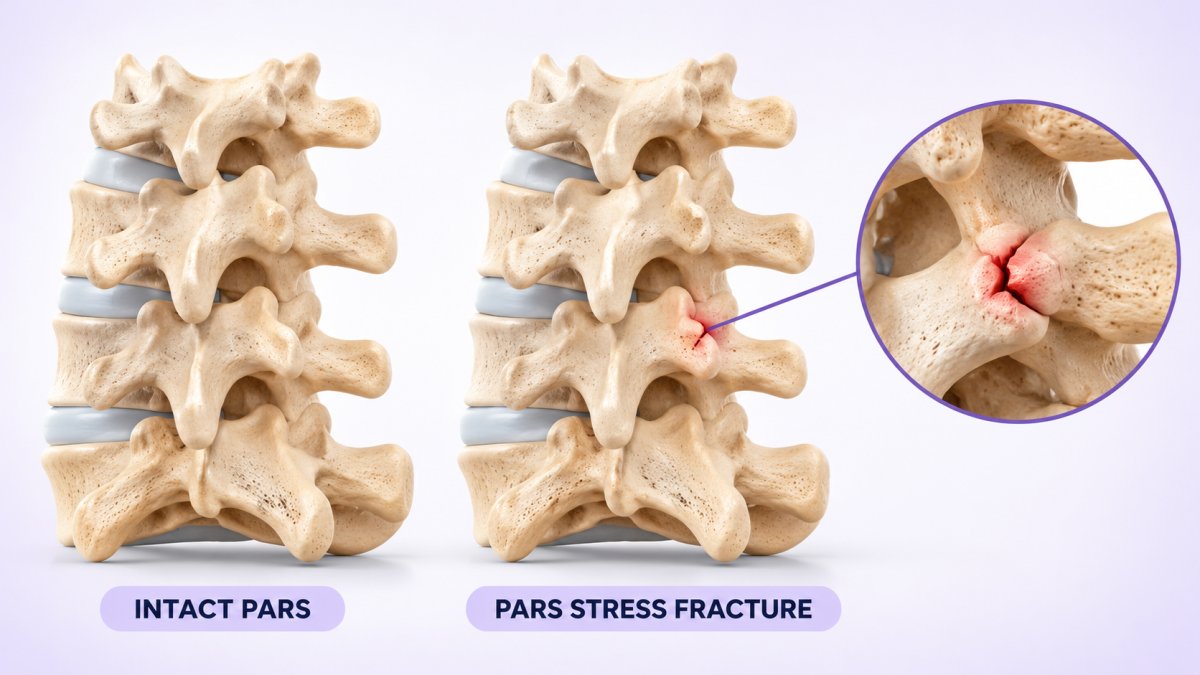
Spondylolysis is a crack or stress fracture in the pars interarticularis, a small bridge of bone at the back of a lower spine vertebra. It can affect one side or both. It is common in young athletes whose sports need repeated back arching, and fast bowling is a classic example.
Spondylolysis is not the same as spondylolisthesis. In spondylolisthesis, a vertebra slips forward over the one below it. The two sit on the same continuum, which is why follow-up matters. Most young athletes with spondylolysis return to full sport after accurate diagnosis and conservative care. Surgery for an isolated pars injury is seldom needed.
Why Are Young Fast Bowlers at Risk?
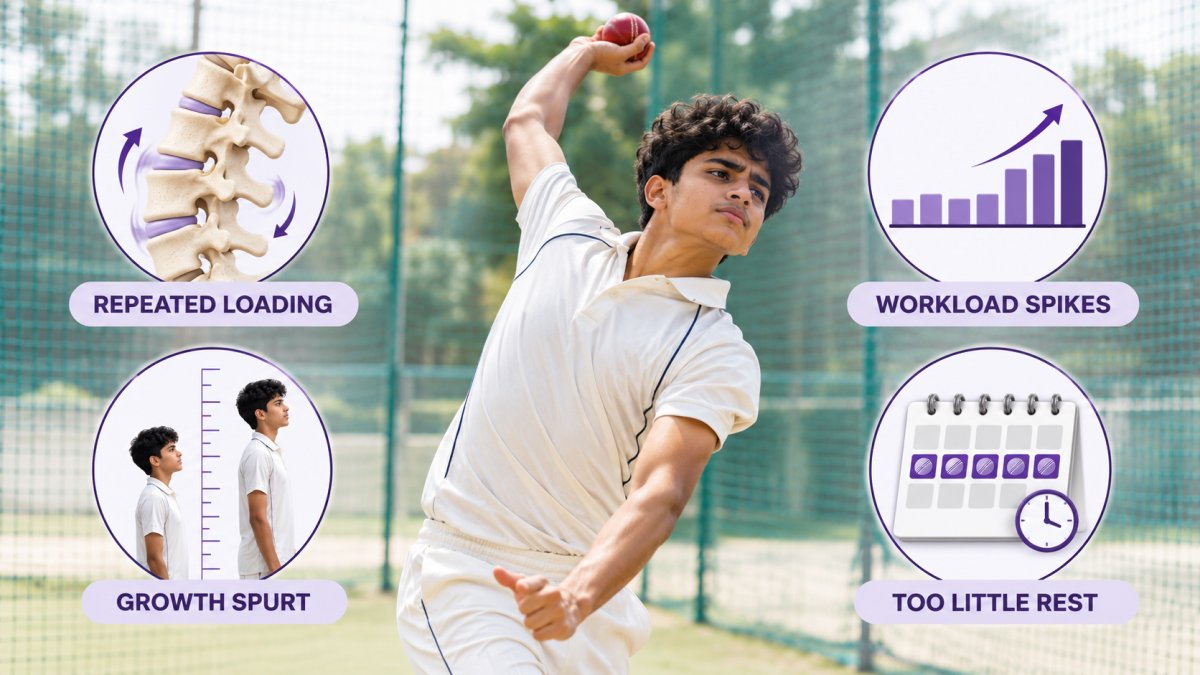
Fast bowling combines back arching, side bend and twist, repeated hundreds of times. A growing spine, a sudden jump in workload and too little rest are a bad mix.
A recent study followed 98 youth bowlers aged 10 to 20 through a season. About 1 in 6 (16.3%) developed a lumbar bone stress injury. Injuries clustered around the growth spurt in mid-adolescence. A past back stress injury was the factor that stayed linked to a new one after adjusting for maturity: bowlers with a previous injury had 3.8 injuries per 10,000 deliveries, against 1.1 overall. Workload spikes showed up within six weeks of diagnosis.
Rest matters too. In a smaller study of 44 junior fast bowlers, those who averaged fewer than 3.5 days between bowling days had about three times the injury risk. That study is old and small, so treat it as a pointer, not a rule.
How to Tell Spondylolysis From a Routine Back Strain
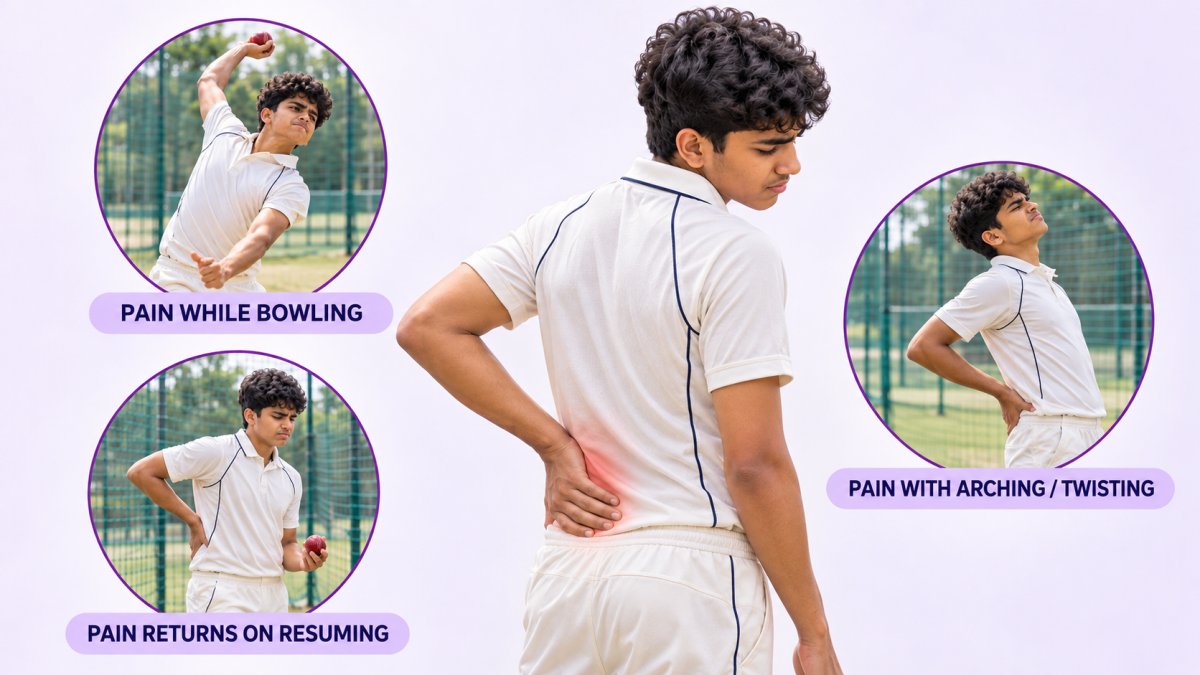
You cannot be sure from symptoms alone. These patterns should make you suspect more than a strain:
- Lower back pain that comes on with bowling, arching or twisting.
- Pain that eases with rest and returns when bowling restarts.
- Pain that sits on one side of the lower back.
- Pain that lasts more than two weeks, or keeps coming back.
- Stiffness or discomfort when the bowler leans back.
The pattern of pain with specific activity, especially extension and rotation, is what sets it apart from a general ache. Pain and scans do not always match, either. A study of 38 elite fast bowlers with no symptoms found clinically significant bone marrow oedema, a sign of bone stress, in 46% of screening MRIs. So "it stopped hurting" does not prove the bone is fine.
A pulled hamstring or tight muscles can also load the back. Read our guide to tight hamstrings and lower back pain and the physio guide to what causes back pain to see how these overlap.
Which Scan Should Parents Ask For?
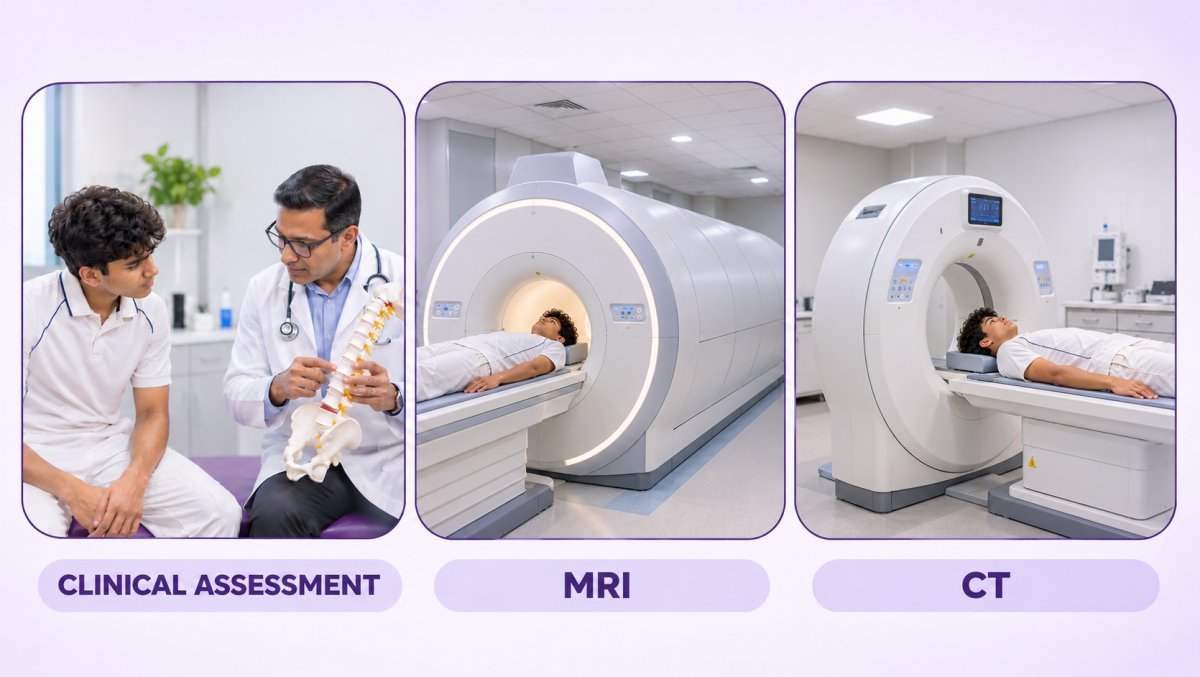
Ask the doctor whether an MRI or a CT scan is right for your child. Both find pars injuries about as well as a bone scan (SPECT), with much less radiation. In one review, the sensitivity of CT was 85% and MRI 80% when compared with SPECT.
MRI has another benefit. With bone-focused sequences, it can follow healing over time without radiation. That matters because a fracture can heal as bone, or as softer fibrous tissue that leaves a defect. A narrative review argues that confirming bony healing can lead to better long-term outcomes in high-demand bowlers. In elite English bowlers, injuries found early on screening MRI had shorter return times.
Your doctor chooses the scan based on age, symptoms and bowling level. Bring the report to your physio.
What Does Physio-Led Rehab Look Like?
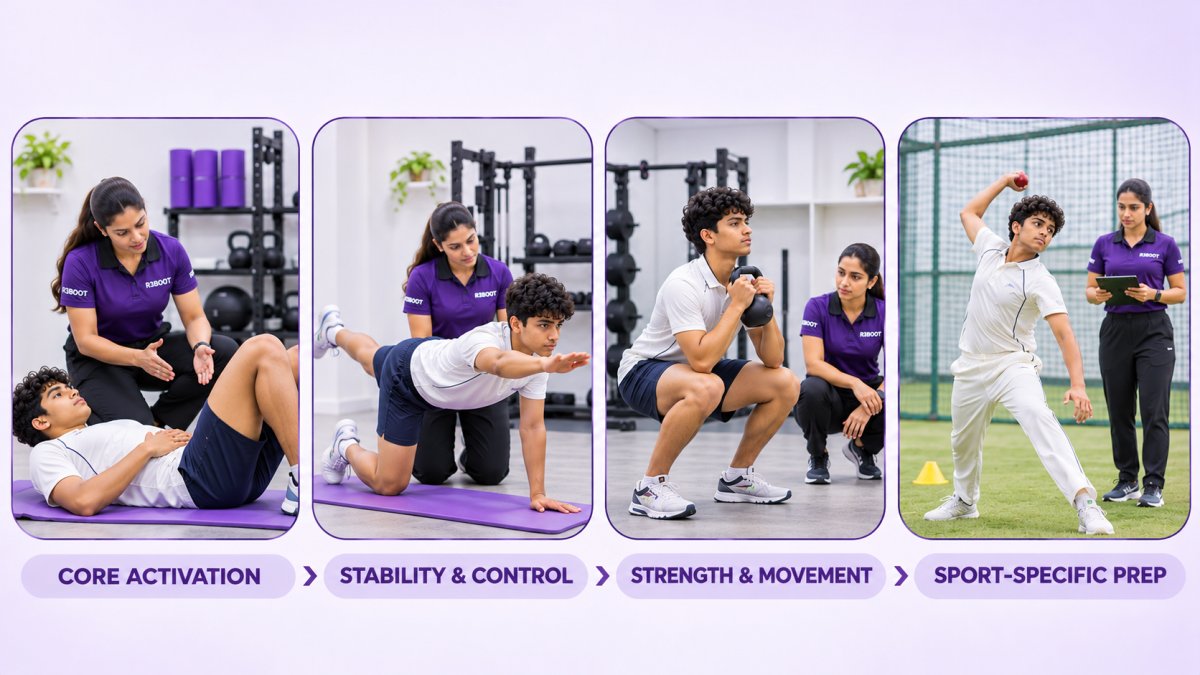
Rehab is built in phases. You move on when criteria are met, not when a week ends.
| Phase | Goal | What it looks like | Moves on when, and timing |
|---|---|---|---|
| 1. Settle | Calm pain, protect the bone | No bowling or heavy arching and twisting. Daily walking. Gentle deep core activation lying down | Daily activities are pain-free. Timing: physio began within 7 days of diagnosis in a 2026 trial |
| 2. Rebuild control | Wake up the deep core and hips | Holds for transversus abdominis and multifidus (deep stabiliser muscles), then arm and leg movements, then squats | Clean form, no symptoms. Timing: weeks |
| 3. Move and load | Full back movement and strength | Normal range in all directions, strength work, running | No pain with exercise; doctor happy. Timing: 6 to 10 weeks if symptoms guide; 3 to 6 months if bone healing is confirmed |
| 4. Back to sport | Throw, then bowl | Graded run-ups and short spells | About half of normal practice done under supervision without symptoms. Timing: built over weeks |
Timing is a range from the literature, not a promise. Your child's date is set by symptoms, scan and testing.
The phase 2 to 4 structure follows a published five-level physiotherapy programme that starts with deep core activation and ends with sport-specific movement.
Do you need to rest first and start physio later? Not necessarily. In a multicentre trial of 64 athletes aged 10 to 19, those who started physio within 7 days returned to sport 38 days sooner, and only 3% had back pain recurrence over 12 months, against 29% in the rest-first group. There were no adverse events. A follow-up analysis reported that resting before physio is not necessary for bony healing on MRI. The doctor still sets the rules, and bowling stays on hold until cleared.
Physio Insider: Dr. Hiral Parikh on spondylolysis in young athletes
What we see and do in clinic with teenage bowlers and other young athletes:
- How it shows up: pain when the back arches (extension), and a positive Quadrant test. That combination makes us suspect spondylolysis rather than a routine strain.
- How we work it out: we look for localised tenderness and muscle spasm, then use the Quadrant test and slump test. X-ray is the first-line scan, and MRI follows when needed. For the first few weeks the athlete avoids hyperextension until the spasm settles.
- Rehab in four phases: phase 1 reduces muscle spasm and pain, with taping. Phase 2 uses isometric strengthening and stabilising exercises for the core and glutes. Phase 3 builds strength in the glutes, core and lower limb. Phase 4 is the return to sport.
- How long: recovery is gradual and differs from athlete to athlete, but it usually takes around 3 months.
- The mistake we see most: young athletes train for strength and skip stability. Core weakness and an imbalance between strength and stability are common. A good programme covers strength, stability, flexibility and mobility together.
- When to stop and see a doctor now: swelling, loss of power, loss of sensation in the gluteal area, or urinary incontinence.
Dr. Hiral Parikh, Lead Physiotherapist, R3BOOT
When Can He Bowl Again?
There is no honest single date. Return depends on three things: symptoms, imaging and sport testing. Pain-guided rest and rehab often runs 6 to 10 weeks. Waiting for scan proof of healing can take 3 to 6 months. The doctor and physio agree which route suits the bowler's level.
Before bowling restarts, a good plan checks:
- No pain with daily life or exercise.
- Full, pain-free back movement in all directions.
- Good control of the deep core and hips.
- Clearance from the doctor, plus a scan if one was planned.
- A staged bowling build, starting with a short, light spell and rising slowly.
Reinjury is real. In the English bowler study, 51% to 67% remained reinjury-free over five years. That is why the return build and the long-term workload plan matter as much as the rehab.
Workload Rules for Coaches and Parents
Workload is the part families can control. These points come from the research above:
- Count every ball. Log nets, matches and school games, not just matches.
- Avoid sudden jumps. The youth bowler study found acute-to-chronic workload spikes (this week against the last few weeks) before diagnosis. A recent review notes this ratio is still debated, so use it as a warning light, not a formula.
- Protect rest days. Do not let a bowler go day after day with no break.
- Watch the growth spurt. A bowler shooting up in height needs extra care.
- Treat a past back injury as a risk flag. It was the strongest link in the youth study.
- Follow your cricket board's current rules for overs per spell and per day. We do not quote numbers here because the rules change.
For athletes of any age, an athlete screening session can flag weak links before a season starts.
Red Flags: See a Doctor Now
“Stop bowling and see a doctor the same day if you notice:”
- Back pain after a fall or hard impact.
- Weakness, numbness or tingling in a leg.
- Numbness around the groin or inner thighs, or trouble passing urine or stool. This is an emergency.
- Fever or feeling unwell along with back pain.
- Constant pain at night or at rest that does not ease.
- Pain that keeps getting worse despite rest.
Common Mistakes That Delay Healing
- Bowling through the pain "to see if it settles".
- Going straight back to full overs after a rest period.
- Stopping rehab when the pain stops, because pain and bone healing are not the same thing.
- Skipping the follow-up scan the doctor planned.
What to Ask the Doctor and the Coach
Ask the doctor:
- Is this a stress reaction, a fracture on one side or both sides, or a slip?
- Which scan is right, and will we repeat it?
- Can he do school PE and other sports in the meantime?
- When can physio start?
Ask the coach:
- How many balls does he bowl each week in nets and matches?
- Who is tracking it?
- What does the first month back look like, and how many rest days are built in?
Next Step in Mumbai
If your child has back pain that keeps returning with bowling, get a doctor's assessment first. Then bring the scan report to R3BOOT in Dadar East. Our team can build a phased rehab and a staged return around it, with sports-focused sports injury physiotherapy.
A 45-minute physiotherapy session at R3BOOT is ₹2,000. Call or WhatsApp +91 97023 68612, or contact us. We are at Palai Plaza, 203, Swami Gyan Jivandas Marg, Dadar East, Mumbai 400014.
Conclusion
Spondylolysis is a stress fracture, not a strain. Catch it early, scan it, and start a phased rehab. The return date is set by symptoms, imaging and testing. Control workload on the way back, because reinjury is the real risk.
Sources
- Goetzinger S, et al. Spondylolysis in Young Athletes: An Overview Emphasizing Nonoperative Management. J Sports Med, 2020.
- Immediate physical therapy is beneficial for adolescent athletes with active lumbar spondylolysis: a multicentre randomised trial. Br J Sports Med.
- Rest Before Physical Therapy Is Not Necessary to Achieve Bony Healing of Lumbar Spondylolysis in Adolescent Athletes. Orthop J Sports Med.
- Management of lumbar bone stress injury in cricket fast bowlers and other athletes. S Afr J Sports Med, 2023.
- Incidence, prevalence and risk factors for symptomatic lumbar bone stress injury in female and male youth cricket bowlers. J Sci Med Sport.
- MRI screening for lumbar bone stress injuries in young male cricket fast bowlers: a 15-year retrospective cohort study. Br J Sports Med, 2025.
- Dennis R, et al. Is bowling workload a risk factor for injury to Australian junior cricket fast bowlers? Br J Sports Med.
- Presence of bone marrow oedema in asymptomatic elite fast bowlers: implications for management. Bone, 2021.
- Quantifying workload and injury risk among cricket fast bowlers: a systematic review and meta-analysis. Cureus.
Physiotherapy in Dadar
Book the assessment, not another stretch routine
If this is changing how you walk, train, or sit at a desk, it belongs with a physiotherapist. R3BOOT is in Dadar East, 5 minutes from the station.
Physiotherapy at R3BOOT Dadar